Case study
The intelligence engine behind a three-store convenience group
Every night, our engine reads the tills across a three-store convenience group and turns them into decisions: what to order, what to price up, what stock to move between stores, and what to stop buying. Plain language, line by line, with the reasoning shown. The owner stays in charge. Nothing is ever ordered or repriced automatically.
What it does
One engine, five kinds of decision
- Ordering: nightly recommendations per store, line by line, with the reasoning shown. Expected sales to the next delivery, what's on the shelf, what's already on order. The operator decides.
- Store-vs-store analytics: a weekly scoreboard and an estate view that compares the stores line by line, so the group's conversations start from the same numbers.
- Pricing: suggestions where a line is priced below the market, run as measured experiments before they're trusted, never blanket increases.
- Dead stock and transfers: which lines to stop buying, and what to move between stores instead of over-ordering, with printable transfer sheets.
- Availability: gaps and suspected stockouts flagged from the till data, so the fix happens before the shelf goes empty for a week.
How it's built
Reads each store's EPOS data every night. No new hardware, no staff retraining, no data entry.
Forecasting, order logic, price-gap detection, dead-stock and transfer analysis. Case sizes, shelf caps and delivery cycles respected.
Morning order sheets per store, weekly scoreboards, and a private reports portal for the group. Written in plain English, readable on a phone in the stock room.
The engine watches its own accuracy nightly, and every claim on an operator's sheet is tested against the code that produced it before it ships.
Every number the operator sees is traced to the code that generated it. New capabilities ship dark, prove themselves in shadow, and only then reach the operator's sheets. The group's third store is being brought onto the engine the same way now.
Nothing is ever ordered or repriced automatically. The engine recommends; people decide.
What the owner sees
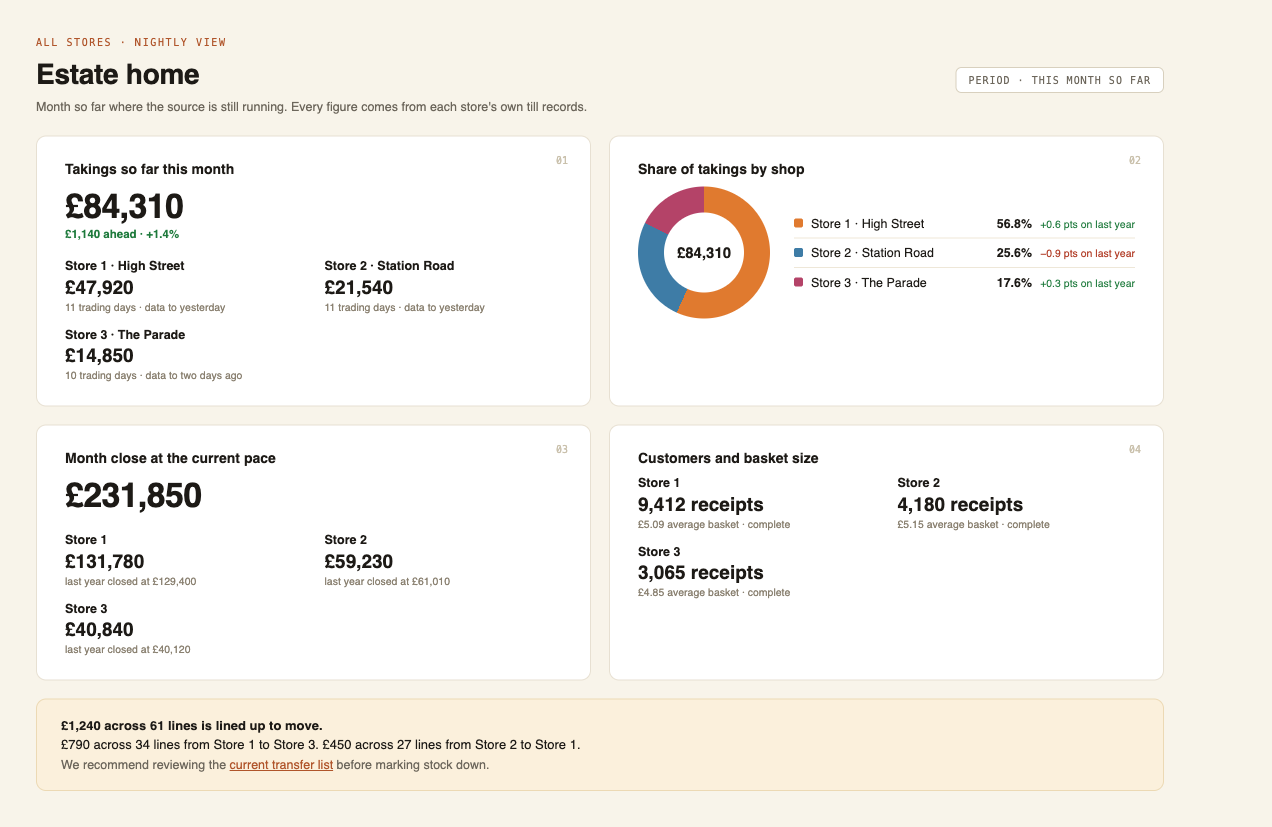
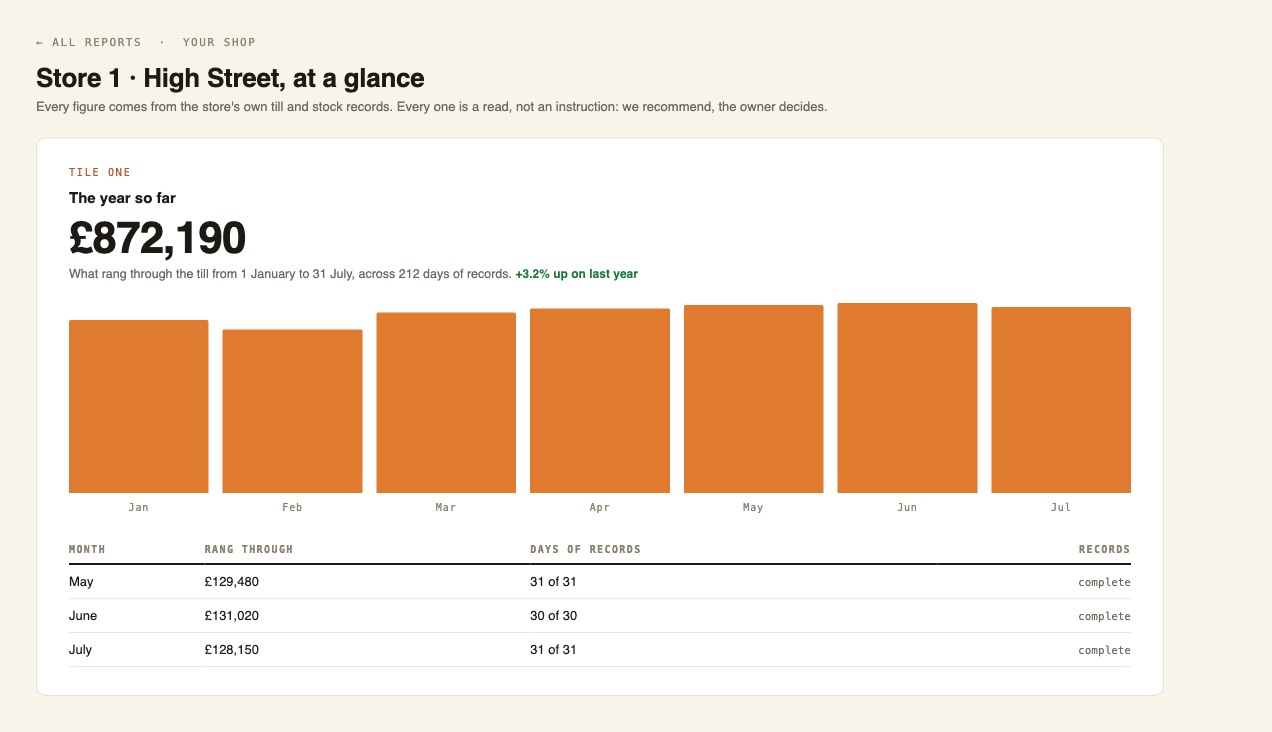
Recreated screens with example figures and store names. The real portal is private to the client.
Why it exists
Three stores, and everything lived in one person's head
Gut feel and memory mostly work, until they don't: gaps on the shelf for the lines that sell, cash tied up in stock that doesn't move, prices that drift below the market, and every decision resting on whoever happens to be in that day.
The hard part of running multiple stores isn't any one decision. It's that the owner can't be in three places, so the discipline that built the first store doesn't automatically reach the second and third.
The owner of a three-store group asked us a simple question: can the data we already have do this better?
Outcomes
What changed once it was live
- Orders matching the sheet's recommendation rose from 4.8% to 23.5% against the pre-engine baseline, measured on the same tolerance rules across both periods.
- The group runs one operating rhythm across all stores: same sheets, same scoreboard, same portal, without the owner needing to be in three places.
- Price moves are tested as experiments with measured results, not guessed. The engine scored 382 of the group's own past price rises, controlled for season and traffic: in 64% the extra margin stuck.
- Slow stock gets named, moved between stores, or stopped, instead of quietly tying up cash.
- The owner keeps full control: the engine recommends, people decide.
What this means for you
Run two or more stores?
This is built for multi-site operators: the ones who know the discipline is in their head and can't clone themselves. If ordering, pricing and stock decisions still live with whoever's on shift, we should talk. First conversation is a phone call, not a pitch deck.
Send us one repetitive job.
We reply within 48 hours with a fix, a price, and a date.